
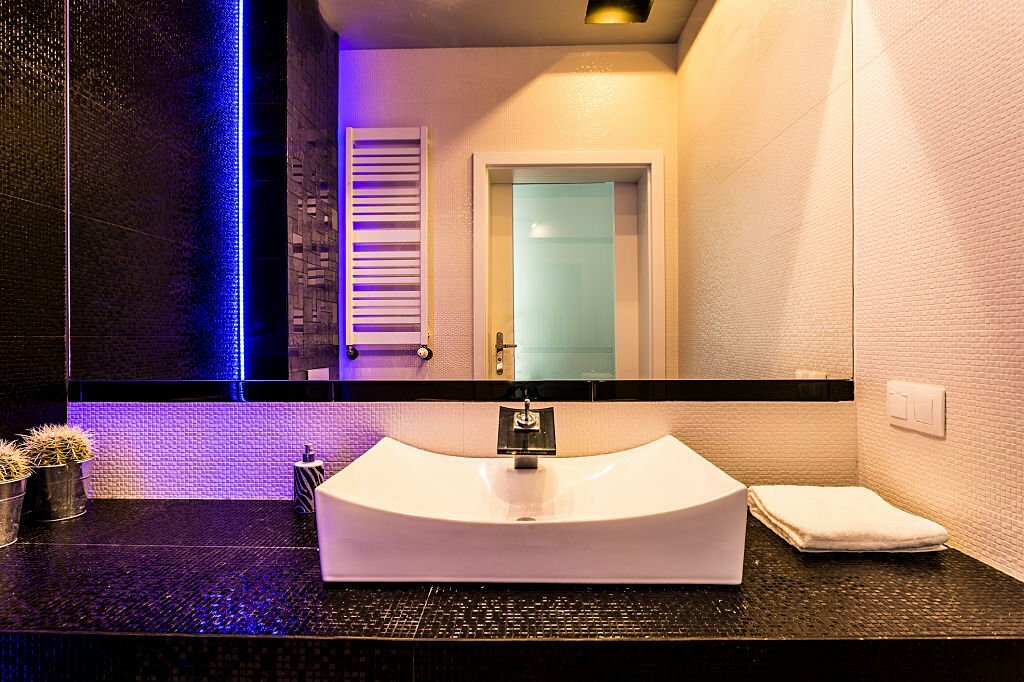
Choose the size of your LED bathroom mirror around the vanity width, usable wall space and reflection you need. A mirror slightly narrower than the vanity often looks balanced, but there is no single compulsory gap. Taps, cupboards, shower screens and the people using the room determine the practical fit.
Use our bathroom mirror sizing tool as a starting point, then tape the outline on the wall before ordering. Explore LED Mirror World Australia once you have a shortlist of widths and heights.
Measure the wall as well as the vanity
Record vanity width, basin position and clear wall space. Then check how far cupboards or doors move, how high the tap sits and where nearby lights or shelves project. For powered mirrors, include the connection position and access to the controls in the plan.
A 60 cm mirror centred above a 75 cm vanity leaves 7.5 cm on either side. That is a useful arithmetic example, not a design rule. An off-centre basin or a cupboard may call for different alignment.
A compact mirror for a smaller basin
The 40 × 50 cm frontlit LED mirror adds dimming, three colour settings, memory and anti-fog in a compact format. Mark both the width and height; a mirror can fit the wall yet still feel too short for regular users.

A circle with equal width and height
The 60 cm HaloGlow backlit mirror has a circular outline, three colour settings, memory and anti-fog. A circle narrows at its top and bottom, so test the usable reflection as well as the overall diameter.

Our round and rectangular mirror comparison explains how shape changes the available reflection. A curved mirror can be practical without being oversized.
A wide reflection above a shared vanity
The 120 × 60 cm frontlit and backlit mirror combines a broad view with dimming, three colour settings, memory and anti-fog. For a double vanity, check the view from both basin positions before deciding between one wide mirror and two individual ones.

Read the 1200 mm double vanity guide and vanity mirror size guide for layouts. Two smaller mirrors may suit separate basins; one broad mirror can create a simpler continuous line.
Set height by the people who use it
Stand at the vanity and test the taped outline at normal viewing distance. Make sure regular users can see comfortably without bending or stretching. Leave room above the tap and beneath nearby lights, and keep touch controls reachable. The centre of the mirror does not have to sit at one fixed eye level for everyone.
Choose lighting after the size is practical. Front light serves grooming, while backlighting adds a glow to the wall. Explore smart mirror features for useful controls and everyday LED mirror benefits for the routine you want to improve.
Turn the outline into a finished installation
Use the dimensions and mounting orientation offered by the chosen product, rather than assuming a stock mirror can be cut or ordered to a custom size. Plan secure fixings for the wall, and use a licensed electrician for fixed wiring or a new power point. A mirror that fits comfortably and works with the room will feel better than one selected only to fill the maximum space.