
Key Takeaways
- Your vanity style, whether modern, classic, Hollywood, or minimalist, should guide the frame material, mirror shape, and lighting format you choose.
- Mirror size should be proportional to the vanity surface and the wall space above it, not chosen in isolation.
- Shape is one of the most expressive design decisions: round mirrors soften structured vanity furniture, while rectangular mirrors reinforce a clean, linear aesthetic.
- Lighting format matters for both function and appearance. Front-lit bulb-style mirrors suit Hollywood and glam setups, while backlit or frameless LED mirrors suit modern and minimalist spaces.
- Frame finish should coordinate with the existing hardware and fixtures in the room, such as drawer handles, lamp bases, and chair legs.
- A mirror that looks right but is poorly lit for makeup application is only doing half its job. Style and function need to work together.
- The room the vanity is in, whether bathroom or bedroom, affects which features are practical requirements versus purely aesthetic choices.
When people set up a dressing table or vanity area, the mirror often gets chosen last. The furniture is selected, the lighting is considered, the storage is sorted, and then a mirror is added to finish the space. This tends to produce setups where the mirror works fine as a reflective surface but feels slightly disconnected from everything around it - either too big, too small, the wrong shape, or with a frame finish that clashes with the rest of the room.
Choosing a makeup mirror that genuinely suits your vanity style is not complicated, but it does require thinking about a few variables at the same time rather than treating the mirror as an afterthought. At LED Mirror World, we find that customers who have thought through their vanity style before choosing a mirror end up with setups that look intentional and work better day to day. This guide covers the main decisions involved and how to approach them for different styles.
Start With Your Vanity Style, Not the Mirror
Before looking at mirrors at all, it is worth being clear about the aesthetic you are working with or building toward. Vanity styles in Australian homes generally fall into a few broad categories, and each one has a fairly natural mirror pairing.
A Hollywood-style vanity typically features a large, often dark or metallic frame with warm, globe-style bulbs running along the top or all four sides. It has a theatrical, deliberately glamorous quality and is usually a statement piece in a bedroom or dressing room. The mirror for this setup is almost always the vanity itself, with lighting integrated into the surround.

A modern minimalist vanity tends toward clean lines, neutral tones, and concealed storage. It suits a frameless or thin-framed mirror with integrated LED lighting that does not draw attention to itself. The mirror should extend the visual language of the furniture rather than compete with it.
A classic or traditional vanity, often with ornate legs, curved edges, and warm-toned timber or painted finishes, pairs well with a mirror that has some decorative detail. An oval shape, a framed edge with some warmth to the finish, or a mirror with subtle ornamental elements looks more considered than a flat frameless rectangle in this context.
A Scandinavian or natural style vanity, with light wood, neutral tones, and functional simplicity, suits a round mirror with a thin natural or matte frame, or a simple rectangular mirror with no frame at all. The key is restraint - nothing too decorative or overly polished.
Knowing which category your vanity falls into gives you a starting point for every other decision. If you are working through this from scratch, reading about how other Australians have approached setting up a dedicated vanity space at home can help clarify the direction you want to take before committing to a mirror style.
Size and Proportion: Getting the Basics Right
Mirror size is the variable most commonly misjudged in vanity setups. A mirror that is too small for the vanity surface looks ungrounded and diminishes the overall setup. A mirror that is too large for the wall or furniture dominates the room in a way that feels unbalanced.
A useful general principle is that a tabletop mirror should sit comfortably within the width of the vanity surface, with space on either side. For a wall-mounted mirror above a vanity, a width that falls between two-thirds and the full width of the furniture beneath it tends to look proportional. Going slightly wider than the vanity can work in larger rooms but needs to be a deliberate choice rather than simply a size that was available.
Height matters equally. A mirror that sits too high above the vanity surface creates a visual gap that feels awkward. A mirror that extends too low may overlap visually with the vanity top or block access to the surface. For seated vanity use, the centre of the mirror should roughly align with eye level in the seated position.
For wall-mounted mirrors in a bedroom vanity context, it is worth measuring the actual wall space before selecting a size, including any artwork, shelving, or lighting fixtures that share the wall. A mirror that looks proportional on a product page may feel cramped once it is competing with other elements in a real room.
This principle extends into smaller spaces too. If you are working with a compact bedroom or apartment setup, exploring practical ways to create a functional lighted vanity area in a limited space can save you from choosing a mirror that overwhelms the room.
Shape and the Visual Language of Your Space
Mirror shape sends a strong visual signal and either reinforces or contrasts with the furniture it sits alongside. Neither approach is wrong, but understanding which one you are doing is important.
Round mirrors are one of the most popular choices for modern and Scandinavian vanity setups because they introduce a soft curve that contrasts the straight lines of rectangular furniture. This contrast tends to feel dynamic and considered. A round mirror on a straight-edged white vanity immediately reads as a deliberate design choice.
Oval mirrors serve a similar purpose but feel slightly more classic and elongated. They suit traditional vanity furniture particularly well and have a slightly more formal quality than a full circle. For taller vanity areas or setups where more vertical reflection is useful, an oval shape can be more practical than a round one.
Rectangular and arched mirrors tend to reinforce linear furniture and suit modern setups where everything is aligned and structured. An arched mirror, with its rounded top and straight sides, is a slightly softer variation that has become very popular in Australian interiors because it bridges modern and transitional styles without being too specific to either.
For dressing rooms or larger vanity stations, a bigger rectangular mirror that fills more of the wall reads as intentional and gives a more complete reflection for full-look assessment beyond just the face.
Our Round Makeup Mirror with Detachable 15X Magnifier is a good example of how a round shape works in a bedroom dressing room context. It brings softness to a structured setup while remaining practical for a full makeup routine.
Frame Finish and Hardware Coordination
The finish of the mirror frame is where cohesion with the rest of the vanity setup is most clearly made or broken. The principle here is straightforward: the mirror frame finish should coordinate with the dominant metal tone or material in the room.
If the vanity has gold or brass drawer handles, a gold-frame mirror or a mirror with warm-toned accents will look intentional. If the hardware is matte black, a black-frame mirror reinforces that choice and gives the whole setup a more resolved appearance. If the vanity is entirely timber with no metal hardware, a frameless mirror or a mirror with a thin natural-toned edge tends to work well.
In practice, an exact match is not necessary and can sometimes feel forced. What matters is that the finishes are in the same family rather than pulling in opposite directions. A gold-framed mirror alongside cool chrome hardware creates a tension that tends to look unintentional rather than eclectic.
Our Arched Gold Framed Frontlit Bathroom Mirror with Anti-Fog is a useful example of a mirror where the frame finish does real design work. The warm gold frame coordinates naturally with brass or gold vanity hardware and warm-toned timber furniture, while the integrated front lighting keeps the whole piece functional for makeup use.
For setups with darker or cooler hardware, a mirror with a black or neutral frame avoids the visual conflict that a warm-toned frame would create. The frame decision should always begin with what is already in the room, not with what looks appealing on its own.
Matching Lighting Style to Vanity Aesthetic
The lighting format of a makeup mirror is as much a stylistic decision as it is a functional one. Different lighting configurations communicate different aesthetics, and the right choice depends on both how the mirror looks and how well it lights your face for makeup.
Hollywood-style mirrors with visible globe bulbs around the perimeter are an obvious choice for glam or maximalist vanity setups. They are deliberately theatrical and work best when the overall setup embraces that aesthetic rather than mixing it with minimalist furniture. Our collection of Hollywood-style mirrors with surrounding globe-bulb lighting covers a range of sizes and frame finishes suited to different room scales and hardware tones.
Our Rectangle Hollywood Makeup Mirror with 20 LED Bulbs is a well-proportioned version of this style. The clean metal frame prevents it from becoming overly decorative, which makes it more versatile than heavily ornate Hollywood mirror designs.
Backlit LED mirrors, where light glows from behind the glass around the perimeter, have a more modern and restrained look. The lighting is present but subtle in its visual effect, making these mirrors suit minimalist or Scandinavian setups where the mirror should not be a focal point. They still provide useful fill lighting for makeup but do not have the same visible drama as bulb-style mirrors.
Front-lit LED mirrors project light directly forward from the mirror face, which gives the most useful illumination for makeup application and tends to look clean and purposeful rather than decorative. These suit modern and transitional vanity styles and are available in both frameless and framed configurations.
Tabletop Versus Wall-Mounted for Different Vanity Styles
Whether a mirror sits on the vanity surface or mounts to the wall is partly a practical decision and partly a stylistic one, and both options suit different setups.
A tabletop mirror gives you flexibility in placement and angle, and it suits a dressing table setup where the mirror is one element among several on the surface. It also requires no installation, which is relevant for renters or anyone who prefers not to put holes in walls. The limitation is that a tabletop mirror adds depth to the surface and can feel crowded in smaller vanity areas.
A wall-mounted mirror clears the vanity surface entirely, which suits minimalist setups where the tabletop is intended to stay uncluttered. It also allows a larger mirror size without the constraints of standing stability, and it gives a cleaner, more intentional appearance. Wall-mounted options require planning for height, electrical access for hardwired LED models, and wall type.
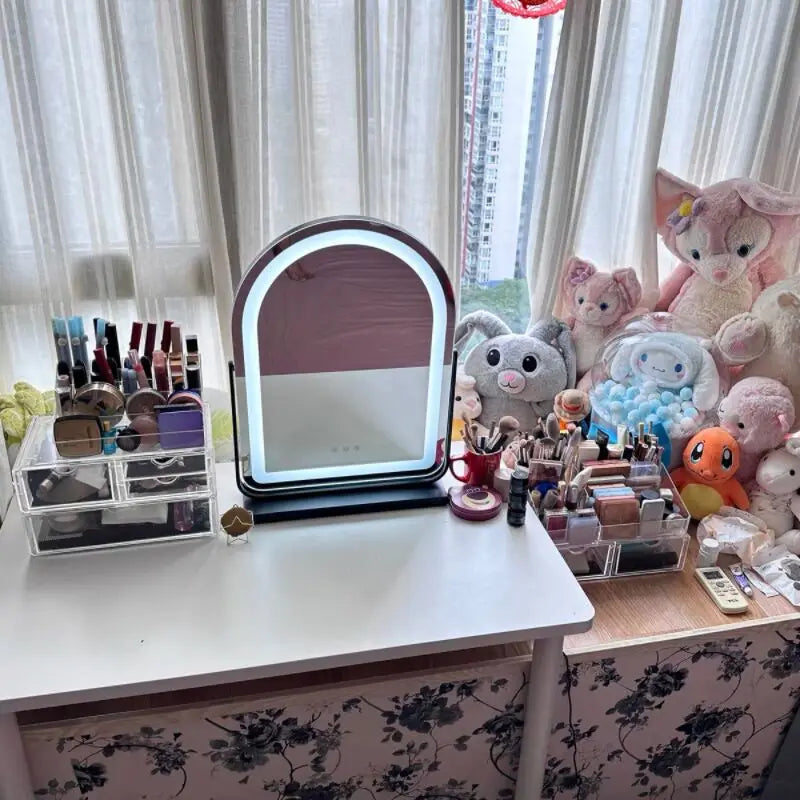
For bedroom vanity setups particularly, the choice often comes down to whether you prefer the look of a clear surface with a floating mirror above it, or the flexibility of a mirror that can be adjusted and repositioned for different tasks.
Our full range of lighted vanity mirrors in tabletop and wall-mounted formats includes varying frame styles and lighting configurations, which makes it easier to find something that suits the furniture already in the room rather than working around a limited selection.
Putting Style and Function Together
The risk with focusing purely on aesthetics when choosing a makeup mirror is ending up with something that looks right in the room but does not actually serve the function well. A mirror with warm, low-CRI lighting that suits the cosy aesthetic of a traditional vanity will consistently produce inaccurate foundation matches. A very small mirror chosen for its proportional elegance may not give enough reflective surface for a full makeup routine.
The most successful vanity mirror choices combine aesthetic alignment with the space and lighting quality that makes makeup application reliable. These are not competing requirements. Understanding how to choose a mirror that works with your vanity rather than against it can help if you are navigating this balance for the first time.
At LED Mirror World, most of the mirrors in our range are designed with both considerations in mind. The lighting specifications are built to support real-world use rather than simply look good in a product photo, and the frame styles are varied enough to suit different room aesthetics without requiring compromise on lighting quality.
If you are working on a specific vanity setup and want guidance on which mirror suits both the aesthetic and the functional requirements of your space, our team is happy to help. Get in touch with us here and we can help you find the right match for your room and your routine.
Frequently Asked Questions
How do I choose a mirror that matches my vanity?
Start by identifying the style of your vanity: modern, Hollywood, classic, or minimalist. Then select a mirror shape and frame finish that coordinates with the furniture's lines and hardware. A round or oval mirror softens structured furniture, while rectangular and arched shapes reinforce clean, linear setups. Frame finish should align with the dominant metal tone in the room, such as gold, matte black, or chrome.
Should a vanity mirror be the same width as the vanity?
A wall-mounted mirror above a vanity ideally sits between two-thirds and the full width of the vanity surface. Matching the full width looks intentional and grounded. Going slightly wider can work in larger rooms but should be a deliberate choice. Tabletop mirrors should fit comfortably within the vanity surface width without overhanging the edges.
What shape mirror suits a modern minimalist vanity?
Round, arched, or clean rectangular mirrors suit modern minimalist vanities well. A frameless or thin-framed option keeps the visual weight low and extends the uncluttered aesthetic of minimalist furniture. Frameless backlit LED mirrors are particularly well suited to this style because the lighting is present but not visually dominant.
What mirror style suits a Hollywood or glam vanity setup?
A Hollywood-style vanity setup is best served by a mirror with visible globe-style LED bulbs around the frame perimeter, which reinforces the theatrical aesthetic. A large, front-lit mirror with a bold metal frame also suits glam setups. The lighting should provide generous, even illumination across the face, which globe-surround and front-lit mirrors do more naturally than backlit options.
Does the mirror frame colour matter for a vanity setup?
Yes, frame colour and finish have a significant impact on how cohesive the overall setup looks. The frame finish should coordinate with the dominant hardware finish in the room. Gold or brass frames suit warm-toned hardware and timber. Matte black frames suit cool or dark-finish hardware. Silver or chrome frames suit contemporary or cool-toned setups. An exact match is not required, but the finishes should belong to the same tone family.
Is a tabletop or wall-mounted mirror better for a bedroom vanity?
This depends on your setup and preferences. Tabletop mirrors offer flexibility in positioning and require no installation, but they take up surface space and are limited in size by standing stability. Wall-mounted mirrors clear the vanity surface and allow for larger sizes, but require planning for height and installation. Minimalist setups often benefit from a wall-mounted mirror, while furniture-focused setups may suit a tabletop option that sits as part of the overall composition.
Can a makeup mirror be both stylish and functional for accurate makeup application?
Yes, and this is the goal worth aiming for. A mirror that looks right in the room but has poor lighting will consistently produce inaccurate makeup results. Look for a mirror with adjustable colour temperature and a CRI of 90 or above alongside the frame style and shape that suits your vanity. Most quality LED mirrors are designed to deliver on both criteria rather than prioritising one over the other.