
Key Takeaways
- The quality of your mirror directly affects the skincare decisions you make - poor lighting and low-detail reflection lead to missed issues and inconsistent results
- High-CRI LED lighting in a mirror reveals skin condition more accurately than standard bathroom lighting, making it easier to assess texture, hydration, and problem areas
- Magnification supports the close-up observation that effective skincare requires - spotting early congestion, dry patches, and uneven product absorption is harder without it
- Anti-fog functionality keeps the mirror usable immediately after cleansing or steaming, which is when you most need to assess your skin
- A well-chosen skincare mirror is a practical tool, not an indulgence - it makes your routine more accurate, more consistent, and more efficient over time
Skincare is one of the most observation-dependent daily practices most people maintain. You're constantly assessing your skin - how it looks after cleansing, whether a product is absorbing evenly, whether a treatment is working, where to apply targeted serums, whether redness is improving or worsening. Every one of those assessments happens in a mirror. And yet the mirror itself rarely gets considered as part of the skincare toolkit.
Most people use whatever mirror is already in the bathroom. A fixed overhead light. A reflective surface chosen for its appearance rather than its function. The result is that skin assessments happen under conditions that are often inadequate for the task - dim, poorly coloured light that flattens detail, a standard reflective surface that misses the fine-grained information that skincare decisions depend on.
A proper mirror - one with high-quality LED lighting, appropriate magnification, and the right specifications for skin assessment - changes the quality of those observations significantly. At LED Mirror World, we think about mirrors as functional tools alongside decorative ones. Here's why the mirror you use for skincare genuinely matters.

What "Seeing Your Skin Clearly" Actually Requires
The phrase "see your skin clearly" is used loosely, but there are specific optical and lighting conditions that determine whether you're actually getting an accurate picture of your skin's current state.
Light quality. Standard bathroom lighting - particularly warm incandescent or low-CRI LED downlights - suppresses surface detail and distorts colour. Redness appears less pronounced. Dry patches read as even texture. Areas of congestion or early breakouts are less visible. The skin looks smoother and more even than it actually is under these conditions, which leads to under-treatment and missed early interventions.
High-CRI LED lighting (90 and above) renders skin colour and texture close to how it appears in natural daylight. This means redness, uneven tone, fine texture changes, and moisture levels are visible with considerably more accuracy. What you see in the mirror corresponds more closely to what's actually happening at the skin's surface.
Light direction. The direction light falls from determines which features of the skin are revealed or hidden. Overhead light, common in Australian bathrooms, creates downward shadows that hide texture detail in areas beneath the brow, under the nose, and around the jaw. Even, multi-directional lighting - as produced by a frontlit or perimeter-lit LED mirror - illuminates the face from all relevant angles simultaneously, reducing shadow-obscured areas and giving a more complete picture of the skin's surface.
Reflective quality and magnification. Standard bathroom mirrors provide a general view of the face at normal scale. For skincare assessment that involves identifying early congestion, monitoring a specific treatment area, or applying products to precise zones, a standard reflection is often insufficient. Magnification brings the skin to a level of detail where meaningful assessment is possible.
The Specific Skincare Tasks That Benefit Most from a Better Mirror
Not all skincare steps require detailed observation - applying a broad moisturiser, for instance, doesn't demand high optical precision. But several common skincare tasks are significantly better performed with an appropriate mirror.
Cleansing assessment. Checking that cleansing has been thorough - no remaining makeup, SPF residue, or product buildup in the hairline, around the nose, or near the jaw - is easier with even, high-quality lighting that reveals residue clearly. This is particularly relevant for double-cleansing routines where the second cleanse is intended to reach the skin surface properly, not just remove layers of other products.
Identifying problem areas early. Early-stage congestion, the beginning of a breakout, or the subtle onset of a dry patch are all easier to catch and address when you can see them clearly. Under warm, low-quality lighting, these early signs are often not visible until they've progressed further. A mirror with high-CRI neutral lighting reveals these changes at an earlier stage, when treatment is typically simpler.
Targeted product application. Serums, spot treatments, eye creams, and prescription topicals often need to be applied to specific areas rather than broadly across the face. Seeing clearly where you're applying, and checking that the product has been absorbed or distributed as intended, is more accurate with even lighting and - for close-up work - appropriate magnification.
Monitoring treatment progress. If you're tracking the response of your skin to a new product, a treatment for hyperpigmentation, or a prescription topical, the ability to observe changes at a detailed level over time depends on the mirror you're using. Inconsistent lighting conditions between observations make it hard to distinguish genuine improvement from lighting variation.
Post-steam and mask assessment. After facial steaming or a clay mask, skin texture and pore appearance are temporarily more visible. Assessing the results of these treatments accurately requires good lighting and, for close-up detail work, magnification - ideally in a mirror that's fog-free and immediately ready to use.
Why Magnification Matters for Skincare Specifically
Magnification is often discussed in the context of makeup - precision liner, brow detail, false lashes. But its value for skincare is arguably greater, because skincare decisions based on skin assessment benefit from a level of visual detail that standard mirrors don't provide.
A 5x to 10x magnifying mirror brings the skin surface to a scale where individual pores, early congestion, and texture changes are clearly visible. This level of detail is useful for assessing whether a pore-clearing treatment is working, identifying the location and stage of developing blemishes, checking product absorption, and monitoring the boundary of a targeted treatment area.
Magnification above 10x is available but tends to narrow the field of view to a very small area, which is more useful for specific precision tasks than for general skin assessment. For most skincare purposes, a 5x to 10x option - particularly in a detachable or secondary mirror that can be used alongside a standard reflective surface - provides the right balance of detail and usable viewing area.
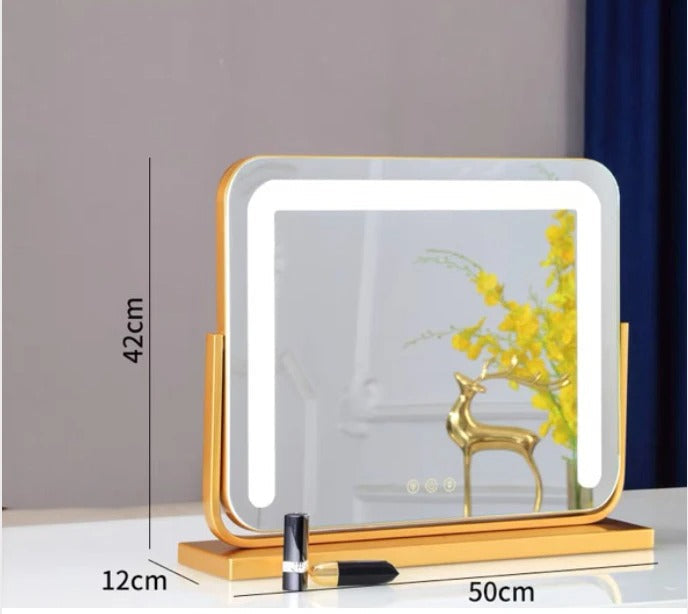
Our Round Tabletop Makeup Mirror with 360° Rotation is designed for exactly this kind of use - the 10x magnification is sufficient for detailed skin assessment, and the three adjustable colour modes allow you to choose neutral or cool light that reveals surface detail accurately.
Anti-Fog: More Relevant to Skincare Than It Might Seem
Anti-fog functionality is a feature often considered primarily in the context of post-shower convenience. But for skincare routines specifically, it has a more fundamental relevance.
Many effective skincare routines involve warm water cleansing, facial steaming, or hot shower-adjacent bathroom activity. All of these introduce steam into the bathroom environment and cause standard mirror surfaces to fog within moments. A mirror that needs several minutes to clear after cleansing is unavailable exactly when you need it most - immediately after completing the step that prepares the skin for assessment and subsequent product application.
An anti-fog mirror with a built-in demister pad maintains the surface above the dew point, keeping it clear throughout these activities. For a skincare routine where assessment happens immediately after cleansing or steaming, this is a practical functional advantage rather than a convenience feature.
Our Rectangle Frontlit Bathroom Mirror with Memory Function is a compact wall-mounted option that combines anti-fog functionality with adjustable LED lighting and memory settings - a combination that suits a dedicated skincare-focused bathroom mirror well. The memory function ensures it restores your preferred lighting settings on each use, which supports the consistency of observation conditions that effective skincare monitoring requires.
For more on how anti-fog functionality works and why it matters in Australian bathrooms specifically, our post on why anti-fog mirrors are particularly useful in humid conditions covers the practical detail.
Colour Temperature and Skincare Assessment
Colour temperature affects what you see in the mirror in ways that are particularly consequential for skincare assessment. The three practical ranges - warm white (2700K to 3000K), neutral white (3500K to 4500K), and cool white (5000K and above) - each render skin differently.
Warm light softens the appearance of redness, uneven tone, and surface texture. This is flattering but counterproductive for skincare assessment, where seeing these features accurately is the point. A skincare routine conducted under warm light will consistently underestimate the degree of redness, congestion, or texture irregularity present.
Cool white light reveals surface detail, texture, and colour variation more clearly than any other setting. For skincare assessment specifically - as opposed to makeup application, where a neutral setting is generally more appropriate - a setting toward the cooler end of the neutral range (around 4000K to 5000K) produces the most useful view of the skin's actual condition.
Mirrors with adjustable colour temperature allow you to use a cooler setting for skincare assessment and shift to a warmer or more neutral tone for other routine steps. This flexibility supports more accurate skincare decisions without requiring separate mirrors for different purposes.
Our post on how LED lighting colour temperature affects skin assessment provides a more detailed breakdown of how each temperature range renders skin and which tasks each is most suited to - useful reading before choosing a mirror for a skincare-focused setup.
Choosing the Right Mirror for a Skincare-Focused Setup
The specifications that matter most for a skincare mirror overlap substantially with those that suit general grooming and makeup application - high CRI, adjustable colour temperature, good light distribution - but with a few additional priorities.
Magnification availability is more important for skincare than for many other tasks. A mirror with an integrated or detachable magnifying zone covers close-up assessment without requiring a separate mirror for that purpose.
Anti-fog functionality is worth prioritising for a bathroom mirror used in a skincare context, where steam-generating activity is common immediately before and during the routine.
Wall-mounted formats with consistent positioning suit skincare routines particularly well because they support consistent observation conditions across repeated sessions. When the mirror is in the same position with the same lighting settings each day, you're comparing observations under the same conditions - which makes monitoring skin changes over time more reliable.
At LED Mirror World, our LED makeup mirror collection includes options with the magnification, adjustable lighting, and anti-fog features that work well for dedicated skincare routines. Our Frameless Rectangle Double Light Bathroom Mirror with Anti-Fog combines both lighting types in a wall-mounted format that suits the full range of skincare assessment tasks - from post-cleanse checking to targeted product application and treatment monitoring.
For more on how to use magnifying mirrors effectively within a skincare context, our post on how to incorporate magnifying mirrors into a skincare routine covers practical techniques for getting the most from close-up observation.
Treating the Mirror as Part of Your Skincare Investment
People invest meaningfully in skincare products - serums, actives, treatments, SPF. The results of those products depend significantly on how accurately they're applied, how consistently skin condition is monitored, and how well early changes are identified and responded to. All of those things depend on what you can see in the mirror.
A mirror that supports accurate observation is not an accessory to a skincare routine. It's a foundational part of it. Choosing one with the right lighting, appropriate magnification, and practical features like anti-fog is as considered a skincare decision as choosing the right cleanser or treatment serum.
At LED Mirror World, we're happy to help you identify the right mirror for your skincare setup and space.
Get in touch with the LED Mirror World team and we'll help you find the right option for your routine.
Frequently Asked Questions
What type of mirror is best for a skincare routine? A mirror with high-CRI LED lighting (90 or above), adjustable colour temperature, and optional magnification is well suited to skincare use. Anti-fog functionality is a practical addition for bathrooms where steam from cleansing or showering would otherwise obscure the mirror surface when you need it most.
Why does lighting matter for skincare mirror use? The quality and colour of lighting determines what skin features are visible in the mirror. Warm, low-CRI lighting softens the appearance of redness, texture, and uneven tone - which leads to inaccurate skin assessment and under-treatment. High-CRI neutral to cool light renders these features accurately, supporting better-informed skincare decisions.
What magnification level is useful for skincare? A 5x to 10x magnifying mirror provides sufficient detail for most skincare assessment tasks - identifying early congestion, monitoring treatment areas, checking product absorption. Magnification above 10x narrows the field of view and is more suited to very specific precision tasks than general skincare observation.
Does colour temperature affect skincare assessment in a mirror? Yes. Cooler white light in the 4000K to 5000K range reveals surface detail, texture, and colour variation more accurately than warm light. For skincare assessment specifically, a neutral to cool setting provides a more reliable picture of the skin's condition than a warm setting, which softens and flatters rather than accurately representing the skin's surface.
Why is anti-fog useful for a skincare mirror? Skincare routines frequently involve warm water cleansing, facial steaming, or hot shower activity that introduces steam into the bathroom. A standard mirror fogs over during or after these activities - exactly when you need the mirror for post-cleanse assessment and product application. An anti-fog mirror with a demister pad stays clear throughout, making it immediately usable at each step of the routine.
Can I use a bathroom LED mirror for detailed skincare work? Yes, provided it has sufficiently adjustable lighting and, if needed for close-up work, an integrated or supplementary magnifying surface. A wall-mounted LED bathroom mirror with adjustable colour temperature, anti-fog, and good light distribution is well suited to both general skincare assessment and most targeted application tasks.
How does a proper mirror improve skincare results over time? Consistent, accurate observation under reliable lighting conditions allows you to identify skin changes earlier, apply products more precisely, and monitor treatment progress more reliably. Over time, this supports more responsive and effective skincare decisions compared to routines conducted under variable or poor-quality lighting.