
A vanity wall is one of those interior projects that looks effortless in the finished photos and feels genuinely complicated while you are planning it. The mirror is the obvious centrepiece, but the wall around it, the furniture beneath it, the lighting within it, and the objects arranged near it all have to work together. Get those relationships right and the result looks considered and intentional. Get them wrong and it looks like a collection of things that ended up in the same place.
The good news is that a Hollywood mirror does a significant amount of the visual work for you. It is large, it is lit, and it is inherently structured. The surrounding decisions become clearer once the mirror is chosen, because everything else is calibrated to support it rather than compete with it.
At LED Mirror World, we help customers across Australia put together setups that work both functionally and visually. This guide covers the practical process of building a statement vanity wall around a Hollywood mirror, from the initial planning decisions through to the finishing details.
Start With the Wall, Not the Mirror
The instinct for most people is to choose the mirror first and then figure out where it goes. A more reliable approach is to start with the wall itself - its dimensions, its position in the room, its relationship to natural light, and what is already around it.
A statement vanity wall works best on a wall that has clear, uninterrupted space. Walls with doors, windows, built-in wardrobes, or power points in awkward positions create constraints that affect both the mirror placement and the overall composition. Before choosing a mirror, identify which wall in the room offers the cleanest canvas. That is the wall to build around.
Consider natural light. A wall that receives direct morning light will interact with the mirror's LEDs differently than a shadowed internal wall. Neither is inherently better, but understanding the light conditions helps you set expectations for how the finished setup will look at different times of day.
Also check where the power points are. A vanity wall with a cord running visibly across the surface to a distant outlet is one of those details that undermines everything else about the design. Knowing where power is available before you finalise mirror placement lets you plan cord routing from the start rather than solving it after installation.

Choosing a Mirror That Commands the Wall
Not every Hollywood mirror makes a statement in equal measure. The size, frame style, and bulb arrangement all affect how much the mirror anchors the wall versus simply hanging on it.
For a true statement setup, the mirror should occupy a meaningful proportion of the wall space. This does not mean filling every centimetre - visual breathing room is important - but it does mean choosing a mirror large enough to feel like it was selected for this specific wall rather than placed there by default. A mirror that is too small for the wall it occupies reads as hesitant. One that is proportioned correctly reads as deliberate.
Frame style matters too. A clean metal frame in matte black, brushed gold, or chrome creates a defined visual border that reinforces the mirror's role as the wall's centrepiece. More ornate frames can work in the right interior context, but they introduce additional visual complexity that needs to be managed carefully in the elements surrounding the mirror.
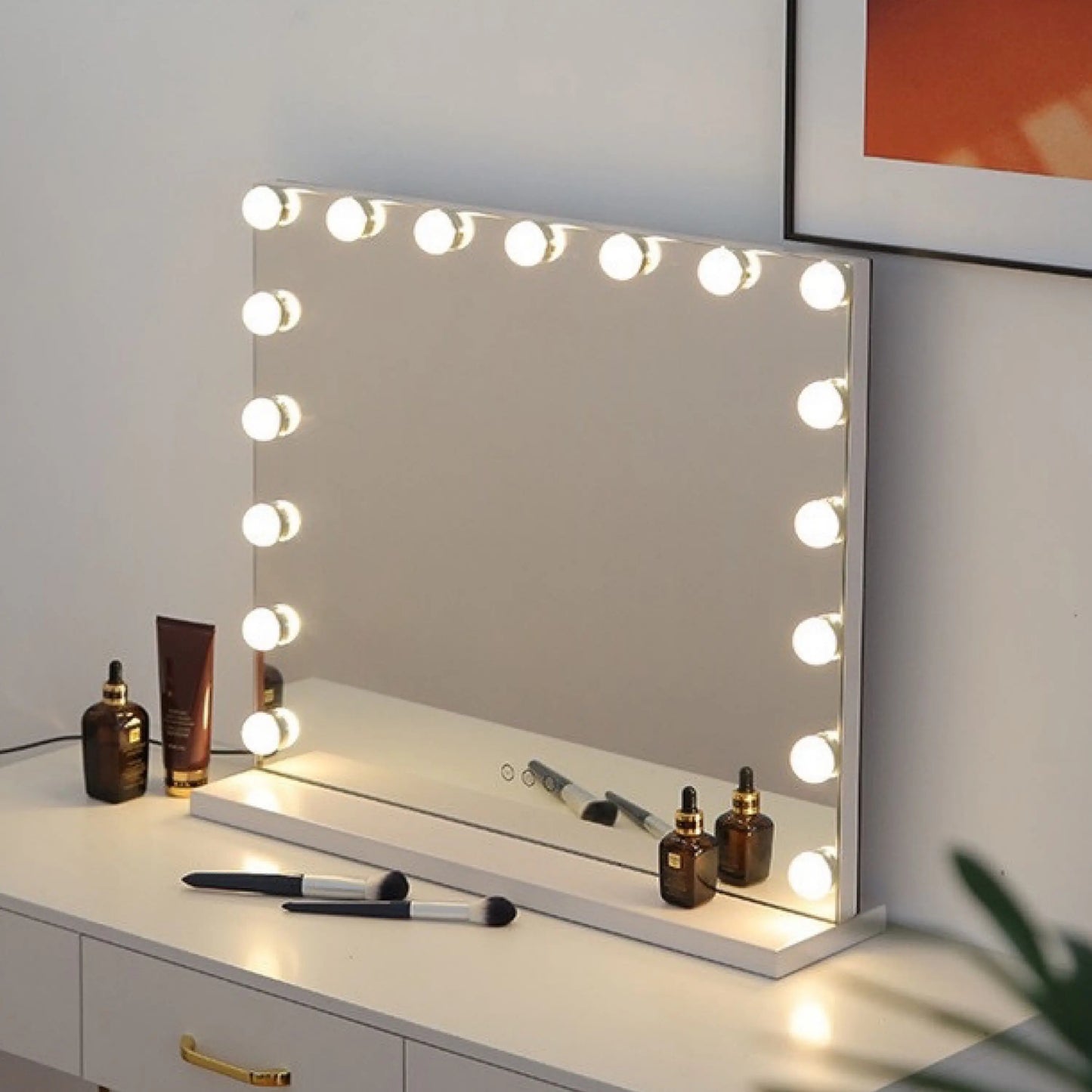
The Rectangle Hollywood Makeup Mirror with 20 LED Bulbs is a well-proportioned option for a dedicated vanity wall. At 80x60cm, it is large enough to command a wall above a standard dressing table without overwhelming a typical bedroom. The clean metal frame and 20-bulb arrangement give it both visual structure and strong lighting output.
For those who want a larger footprint with additional features integrated into the setup, the Rectangle Smart Hollywood Makeup Mirror with Bluetooth & USB Port adds three-colour lighting modes and built-in audio, which reduces the number of separate devices needed in the vanity space and keeps the setup cleaner overall.
The Furniture Below: Building the Right Base
The relationship between the mirror and the surface beneath it is one of the most important compositional decisions in a vanity wall. A mirror floating above a surface that is too narrow, too busy, or poorly proportioned will look disconnected regardless of how good the mirror is.
The ideal relationship is one where the surface width is similar to or slightly narrower than the mirror above it. This creates a visual column from furniture to mirror that reads as intentional composition rather than two separate objects sharing a wall. A dressing table or dedicated vanity desk with clean lines and a clear surface is the standard base for this kind of setup.
Surface height matters too. The mirror should be mounted so that its reflective centre sits at or near eye level for the person using it, whether seated or standing. This is not purely a functional consideration - a mirror mounted too high or too low relative to the surface below it disrupts the visual relationship between the two objects and makes the overall composition feel off.
The surface itself should be treated as part of the composition rather than a place to put things. A small number of curated objects - a perfume, a tray, a plant, a candle - contribute to the overall aesthetic. A cluttered surface competes with the mirror and dilutes the impact of the whole wall.
Wall Colour and Background Treatment
The wall behind and around a Hollywood mirror sets the backdrop for the entire composition. Getting this right amplifies the mirror's visual impact. Getting it wrong can make even a well-chosen mirror feel flat.
Deeper wall colours - charcoal, navy, forest green, warm terracotta - create high contrast against the mirror and its light, which gives the setup drama and presence. They tend to suit bedrooms and dressing rooms with a more opulent or deeply styled aesthetic.
Lighter walls - white, soft grey, warm off-white - keep the background neutral and let the mirror's light do more work. The setup feels cleaner and more contemporary, and the wall recedes so the mirror is clearly the foreground element. This approach suits a wider range of interior styles and is more forgiving if the surrounding accessories are still being refined.
Some people opt for a feature treatment on the vanity wall specifically - a different paint colour from the rest of the room, a wallpaper panel, or a textured finish. When done well, this frames the vanity wall as a deliberate interior moment within the room. It signals that the space was designed rather than assembled. If this approach appeals, keep the treatment contained to the vanity wall itself and ensure it complements rather than competes with the mirror's frame colour and the furniture below.
Lighting Beyond the Mirror
A Hollywood mirror produces a significant amount of light, but it is not the only light source a vanity wall benefits from. The interaction between the mirror's LED output and the ambient light in the room affects how the whole setup reads at different times of day.
During the day, natural light entering the room from the side or behind the person using the mirror fills in the ambient light around the vanity comfortably. In the evening, the mirror becomes the primary light source for the vanity area, and the contrast between the lit mirror and a darker surrounding room can actually look quite striking - the wall becomes a composition of light and shadow rather than just a flat surface.
Supplementary lighting on either side of the vanity wall - small wall sconces, for example - can balance this evening effect and add depth to the overall composition. These do not need to be complex installations; even small additions of warm ambient light to the sides of the mirror help the setup look more considered after dark.
Dimmable mirrors are particularly valuable in this context. The ability to adjust brightness to suit the time of day and the ambient lighting conditions in the room means the vanity wall performs well in all conditions rather than looking perfect in some and problematic in others. Our article on how the benefits of using a mirror with adjustable brightness affect daily use goes into more detail on this if the lighting range of your setup is a priority.
Accessorising the Vanity Wall Without Overcrowding It
Accessories are where many vanity walls lose their way. The temptation is to add things over time - an extra shelf, more products on the surface, a small piece of art beside the mirror - until the wall gradually shifts from a composed statement to a cluttered corner.
The principle to work with is restraint. A small number of well-chosen accessories that relate to each other in colour, material, or proportion will always look better than a larger number of objects that have accumulated without a clear plan.
On the surface: a single tray to corral perfumes or daily-use products, a small decorative object or plant, and nothing else. On the wall around the mirror: nothing, in most cases. The mirror is the art. Adding more wall-mounted objects alongside it splits the focal point and reduces the impact of both.
If storage is a consideration, a bathroom mirror cabinet with integrated storage offers an alternative approach to the open vanity wall - combining mirror and storage in a single unit and keeping the surface below completely clear.
Practical Mounting and Installation Considerations
The execution of the installation is the step that turns a well-planned vanity wall into a well-finished one. A mirror mounted slightly off-centre, or at an angle, or with visible fixings is a distraction that is difficult to ignore once you have noticed it.
Before drilling anything, use a level and mark out the mirror's intended position clearly. Check that the mounting point aligns with wall studs or appropriate anchors for the mirror's weight. Hollywood mirrors are not especially heavy, but the mounting hardware should be appropriate for the specific mirror and wall type.
Cord routing should be planned before the mirror goes up. A cord clipped neatly along the back of the dressing table and into a power point positioned behind or below the surface is far less visible than one running across an open wall. In some setups, a recessed in-wall power point directly behind the mirror makes the installation look completely cordless from the front, which is the cleanest possible result.
For anyone building a more involved setup, our guide on how to create the ultimate vanity space with a Hollywood mirror covers layout planning and setup execution in more depth.
Bringing It Together With the Right Mirror
At LED Mirror World, our Hollywood mirror collection is designed to suit the full spectrum of vanity wall setups - from compact bedroom dressing areas through to dedicated dressing rooms with larger wall space and more elaborate styling ambitions.
The Rectangle Hollywood Makeup Mirror with 17 LED Bulbs is a popular choice for setups where colour temperature flexibility is a priority. The three-colour modes allow the vanity wall to shift between warm and cool lighting to suit both practical use and evening atmosphere, which is a genuine advantage in a bedroom setting where the same wall is used for different purposes at different times.
All LED Mirror World products are SAA certified, come with a three-year warranty, and are shipped from our local Australian warehouse. Free delivery is available across Australia.
If you are planning a vanity wall and want guidance on which mirror suits your specific space, frame preference, and styling direction, our team is happy to help. Get in touch through our contact page and we will get back to you during business hours, Monday to Friday, 9am to 5pm.
Frequently Asked Questions
What is a statement vanity wall?
A statement vanity wall is a deliberately styled section of a room built around a central mirror, typically positioned above a dressing table or vanity surface. The mirror functions as the focal point, and the wall colour, furniture, lighting, and accessories around it are chosen to support and enhance that central element rather than compete with it.
How do I choose the right size Hollywood mirror for a vanity wall?
Measure the wall space and the surface below before selecting a size. The mirror should be proportionate to both - wide enough to feel like a deliberate choice for the space, with clear visual breathing room around the edges. A mirror that is too small for the wall reads as tentative; one that fills the space with some margin looks considered and intentional.
What wall colour works best behind a Hollywood mirror?
Both light and dark backgrounds work, depending on the overall aesthetic of the room. Deeper colours create high contrast and drama. Lighter neutrals keep the background clean and let the mirror's lighting take precedence. The key is that the wall colour should complement the mirror's frame finish and the furniture below rather than competing with either.
How do I manage the cord from a wall-mounted Hollywood mirror?
Plan cord routing before mounting the mirror. The cleanest solution is a power point positioned directly behind the mirror so the cord is entirely hidden. If that is not possible, route the cord along the back of the dressing table surface toward the nearest outlet, using cord clips or adhesive channels to keep it flush with the surface or wall.
Should I add other things to the wall around a Hollywood mirror?
In most cases, no. The mirror works best as the sole wall-mounted element in the composition. Adding additional wall art, shelves, or objects alongside it splits the focal point and reduces the visual impact of the mirror. The surface below the mirror is the appropriate place for a small number of curated accessories.
How high should a Hollywood mirror be mounted on a vanity wall?
The reflective centre of the mirror should be at or near eye level for the primary user, accounting for whether the mirror will be used seated or standing. For a seated vanity setup, this typically places the centre of the mirror around 120cm to 130cm from the floor, though the specific height will vary depending on the user and the furniture height. Using a level during installation ensures the mirror sits straight, which is as important as the height.
Can a Hollywood mirror work as the only light source on a vanity wall?
It can provide sufficient light for the vanity area during use, particularly models with higher bulb counts and dimmable controls. For the broader room, additional ambient lighting is generally still useful, especially in the evening. A dimmable Hollywood mirror can shift between functional task lighting and softer ambient light within its own range, which reduces the need for additional sources directly at the vanity wall.